


IN Rio de Janeiro this week, history quietly unfolded as Malaysia made its debut as a BRICS Partner Country. As the current Chair of ASEAN, Malaysia’s arrival at the summit carried added weight, marking a new chapter not only in its foreign policy posture but also in the evolving role of the Global South.
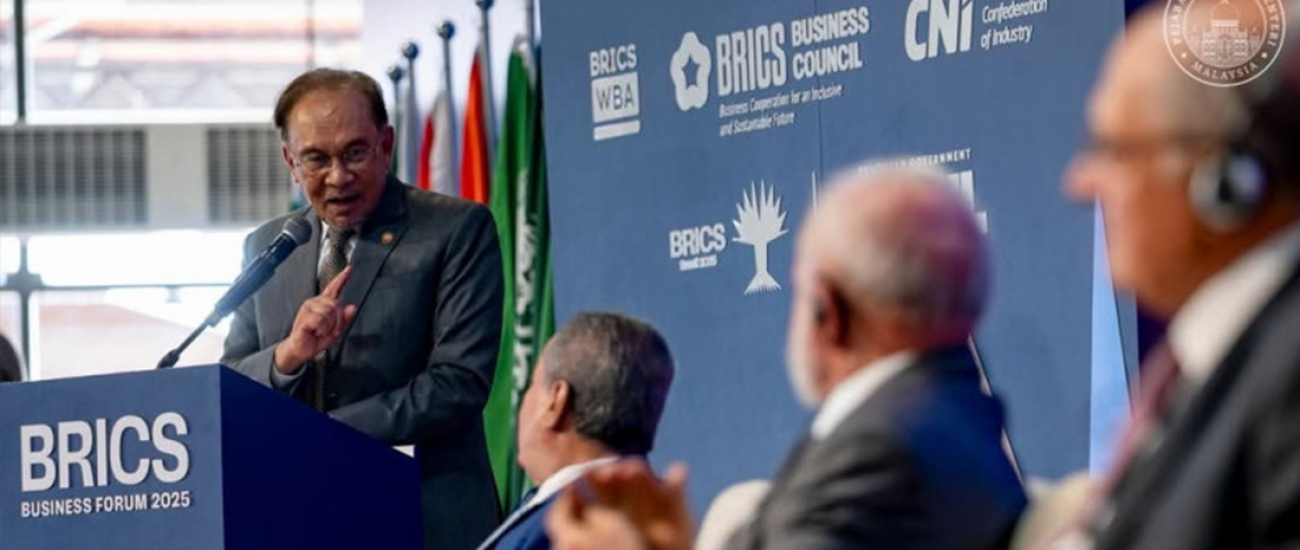
The moment was not merely ceremonial. Shortly after arriving, Prime Minister Datuk Seri Anwar Ibrahim joined Brazilian President Luiz Inácio Lula da Silva on stage to open the BRICS Business Forum. What followed was far from the conventional script of multilateral gatherings.
Speaking without notes and with striking candour, Anwar delivered a rousing address that drew sustained applause from a packed hall. Forgoing formalities, the Malaysian premier offered a heartfelt, lucid message that resonated across the room—an unvarnished expression of Malaysia’s commitment to global reform and the shared aspirations of the developing world.
“The developing world can no longer be seen as peripheral players in a system built elsewhere,” Anwar declared. “We are not relics of post-colonial history. We are rising powers in our own right, armed with moral capital, technological capacity, and economic ambition.”
In his remarks, Anwar commended President Lula’s leadership in transforming BRICS from rhetorical promise to genuine platform, crediting the coalition’s growing inclusivity and civic engagement. “Today’s BRICS,” he noted, “is not just a forum of statesmen. It includes the voices of the private sector, youth, women and civil society.”
Anwar made clear Malaysia’s position: to engage all, defer to none, and reimagine global cooperation frameworks from the perspective of developing nations. As ASEAN Chair, Malaysia brings a regional agenda anchored in multilateralism, financial integration, and local currency use to reduce reliance on the US dollar.
He also proposed new areas for BRICS-ASEAN collaboration, including green sukuk, climate finance instruments, and sustainability-linked vehicles. These, he argued, could become vital tools for systemic transformation—mechanisms to match private capital with public good.
Anwar’s interventions at the BRICS Leaders’ Summit reflected not only Malaysia’s diplomatic clarity but also the broader ambition of the Global South. He called for the urgent reform of legacy institutions such as the United Nations, IMF, World Bank and WTO, urging them to evolve into more responsive, equitable and plural bodies. “Stop being custodians of the past and become instead platforms for a fairer, more plural international order,” he urged.
Anticipating speculation over Malaysia’s geo-economic orientation, Anwar made it clear that its engagement with BRICS is not a pivot away from the West. The United States remains Malaysia’s top source of foreign direct investment, and its third-largest trading partner, with bilateral trade exceeding RM320 billion in 2024. “Any suggestion of a shift, strategic or otherwise, is groundless,” he asserted.
Rather than a counterweight, BRICS represents, in Anwar’s view, a “counterproposal” rooted in shared sovereignty, inclusion and pluralism. It is a model of multilateralism fit for a complex, multipolar world.
If Rio marked the emergence of Malaysia as a confident Global South voice, October’s 47th ASEAN Summit in Kuala Lumpur—where President Lula is expected to attend—may be the next milestone. Malaysia intends to use the summit not as a stage for bravado but to reinforce its vision: to champion AI governance, develop new climate finance frameworks, and align private resources with regional public priorities.
In Rio, Malaysia did not merely participate. It articulated a bold, constructive, and forward-looking agenda. The applause was real—but what comes next will require enduring conviction and purposeful diplomacy.
The Global South, Anwar made clear, will no longer wait to be invited to the table. It is building a new one. – July 9, 2025