

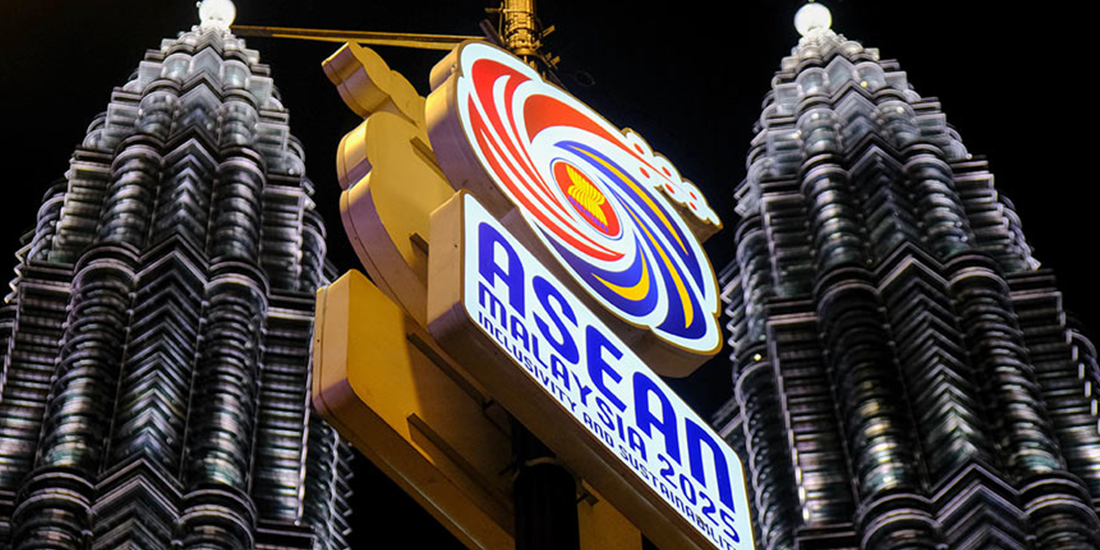
Malaysia’s ASEAN chairmanship in 2025 culminated in the 47th ASEAN Summit and related meetings at the end of October. While the Summit has, as such, received plenty of recognition for its sheer scale and “star presence” — with the likes of US President Donald Trump, Brazilian President Luiz Inácio Lula da Silva and Japanese PM Sanae Takaichi attending — Malaysia’s time as chair has also, without a doubt, reaffirmed with conviction ASEAN’s convening power and commitment to strengthening its mechanisms. This comes against the backdrop of acute geopolitical and geoeconomic flux, major power rivalry, and the rise of regional powers and minilateralism.
Chairmanship Priorities
Malaysia assumed chairmanship with a clear list of priorities – maintain the momentum of previous chairmanships helmed by Indonesia in 2023 and Laos in 2024, reinvigorate ASEAN structures to make them fit for purpose, and support Timor Leste’s accession to ASEAN.
While Timor-Leste’s accession had been anticipated for a few years now, its formalisation during Malaysia’s chairmanship is a testament to Putrajaya’s commitment not only to a more inclusive ASEAN but also to a more connected Southeast Asia.
More pressing priorities that possibly took a backseat, at least in terms of optics, were the Myanmar crisis and the South China Sea dispute – issues on which observers had expected more tangible early progress. Malaysia, to its credit, however, not only kept the lines of communication open, inclusive, and dynamic, but also oversaw the review of the implementation of the Five-Point Consensus on Myanmar and host key ASEAN-China negotiations on the South China Sea, including the 48th Meeting of the ASEAN-China Joint Working Group on the Implementation of the Declaration on the Conduct of Parties in the South China Sea (JWG-DOC). It remains to be seen whether this groundwork will translate into more substantial outcomes during the Philippines’ chairmanship next year.
Staying True to the Theme
Beyond the fanfare surrounding Malaysia’s chairmanship, a grounded assessment of its success really has a lot to do with how much effort Putrajaya put into staying true to and advancing its theme of “Inclusivity and Sustainability”. At first glance, even at the time it was launched, the theme predominantly alluded to shared development, prosperity, and environmental sustainability. And while this interpretation holds, as reflected in initiatives like the ASEAN Centre of Excellence for MSMEs in Green Transition, the Enhanced ASEAN Power Grid (APG) Memorandum of Understanding, the ASEAN Plan of Action for Energy Cooperation 2026-2030, and the APG Financing Initiative being launched – a closer look at the entirety of the chairmanship reveals Putrajaya’s distinct and consistent enterprise to foster inclusive and sustainable partnerships above all.
First, while Timor-Leste’s accession had been anticipated for a few years now, its formalisation during Malaysia’s chairmanship is a testament to Putrajaya’s commitment not only to a more inclusive ASEAN but also to a more connected Southeast Asia. One would recall that Laos and Myanmar also acceded during Malaysia’s ASEAN chairmanship in 1997 – a legacy unforgotten, given the vision of the Founding Nations of ASEAN in 1967 to bring together all 10 Southeast Asian countries into one regional grouping. With Timor-Leste, that aspiration now extends to all eleven.
Connecting the Global South
That being said, accession and assimilation are two different things. It will undoubtedly take some time before Timor-Leste can function on equal footing with the rest of the ASEAN member states. There are opportunities, certainly, with Timor-Leste pegged as the bridge between the Pacific and Southeast Asia, but their realisation remains uncertain. Malaysia’s stance has been for ASEAN to project “geoeconomic magnanimity”: to support Timor-Leste’s membership with a long-term vision of leveraging Dili’s potential as an inter-regional connector. This will only bolster ASEAN’s efforts to connect the Global South on the basis of addressing shared indigenous challenges collectively.
Malaysia’s stance has been for ASEAN to project “geoeconomic magnanimity”: to support Timor-Leste’s membership with a long-term vision of leveraging Dili’s potential as an inter-regional connector. This will only bolster ASEAN’s efforts to connect the Global South on the basis of addressing shared indigenous challenges collectively.
Second, the Summit saw strong representation from all five initial BRICS+ members. Brazil and South Africa, both sectoral dialogue partners of ASEAN, also hold this year’s BRICS+ chair and the G20 presidency, respectively, lending further weight to Malaysia’s push for Global South mobilisation through existing multilateral structures. Prime Minister Anwar Ibrahim has not only called for BRICS+ to emerge as a strong and principled force but has also consistently advocated greater strategic cooperation between ASEAN and BRICS+. This will lead to sustainable outcomes, helping counter the perceptions that BRICS+ is merely a geostrategic pawn designed to counter Western influence.
Including the West
Third, and perhaps most potent, is Malaysia’s ability to adeptly balance ASEAN’s continued engagement with the West while actively pushing for a strengthened and empowered Global South. With the European Union (EU), European Council President António Costa’s call to “weave a global network of cooperation across regions” during the Summit resonated with Malaysia’s promotion of deeper inter-regionalism with ASEAN at the core of these efforts. Malaysia was also able to strike the right chord with the EU’s priorities in the region – primarily human rights advocacy and peace in Myanmar.
Third, and perhaps most potent, is Malaysia’s ability to adeptly balance ASEAN’s continued engagement with the West while actively pushing for a strengthened and empowered Global South.
The United States’ strategic engagement with ASEAN is still in its nascent stages when compared to other long-standing dialogue partners such as Australia and New Zealand. In fact, despite all the hype and anticipation, this is only Trump’s second time participating in an ASEAN Summit in his two terms as US President. The US has struggled to maintain momentum in its ties with ASEAN, often attributed to inconsistent presence and optics. In this context, Malaysia was able to anchor the US presence at the Summit to the Thailand-Cambodia peace deal, an all-of-ASEAN priority, providing a functional basis for sustaining ASEAN-US ties – at least during Trump’s time in office.
Sustaining Regional Partnerships
Another notable initiative that demonstrated Malaysia’s commitment to inclusive and sustainable partnerships was the hosting of the 5th Regional Comprehensive Economic Partnership (RCEP) Summit. This was the first Leaders’ meeting since the RCEP Agreement entered into force in 2022, and the first since the signing ceremony at the 4th RCEP Summit in 2020. This meeting was crucial for injecting new momentum into RCEP’s implementation. While ambitious, the period since its entry into force has not been without challenges. Malaysia’s convening of this meeting was therefore commendable and set the right tone for future chairs.
“Malaysia was able to anchor the US presence at the Summit to the Thailand-Cambodia peace deal, an all-of-ASEAN priority, providing a functional basis for sustaining ASEAN-US ties – at least during Trump’s time in office.”
Malaysia’s ASEAN “moment” has come at a time when the region has been pushed to reckon with both an interregnum and a period of intense geostrategic recalibration. All things considered, there is quiet strength in pursuing safe — rather than merely low-hanging — fruits. There is a calm foresight in choosing to engage on shared terms rather than not engage at all. And there is, ultimately, the humility to recognise the difference between strategic intent and strategic action. Malaysia, despite operating within its own distinct set of challenges, has laid the path for a more connected ASEAN within a more interconnected region. It is now for subsequent chairs to build upon these efforts.
This article was first published in Observer Research Foundation on 28 November 2025.